Deep Groin Pain or Hip AVN: When Is MRI Needed?How the stage of AVN changes the treatment discussion.
Medically reviewed by Dr. Himanshu Gaur
Orthopedic Surgeon. Reviewed 2 Aug 2026.
The short answer
Deep groin pain does not automatically mean AVN. The first step is an orthopaedic examination, often followed by an X-ray. MRI is useful when early AVN is still suspected or when the X-ray does not explain the symptoms. If AVN is confirmed, whether the femoral head has started to collapse is one of the main factors that changes the treatment options.
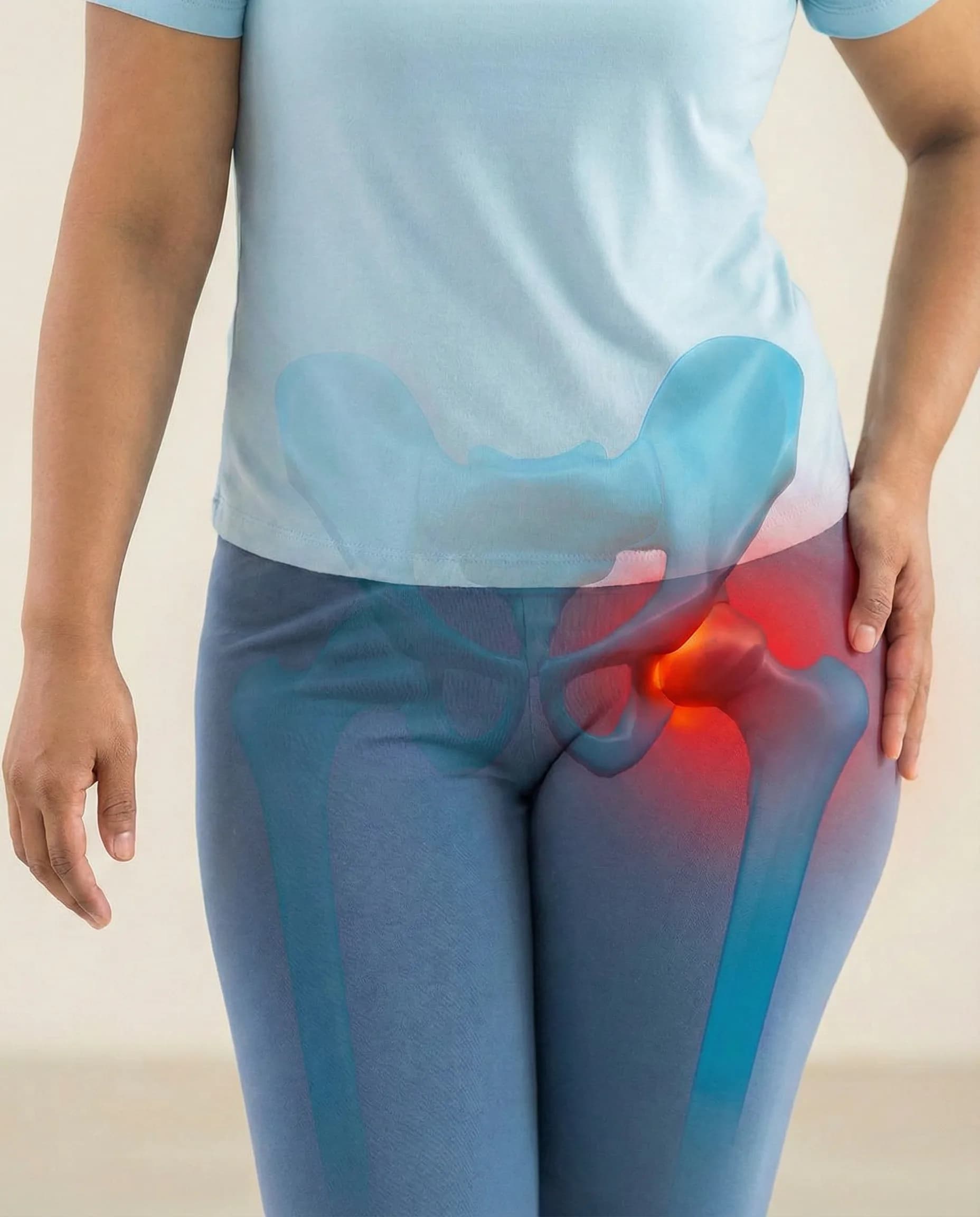
Patients sometimes come to a South Delhi OPD saying, "Doctor, pain kamar ke paas hai, but walking se groin mein badh raha hai." The pain may be from the hip joint, lower back, a tendon, or another nearby structure. AVN is one possibility, especially when the pain feels deep in the groin and weight-bearing is becoming difficult.
AVN should not be diagnosed from symptoms or an online article alone. The examination and imaging stage matter because early disease and a collapsed femoral head are different clinical situations.
What is hip AVN?
AVN stands for avascular necrosis, also called osteonecrosis. It means that part of the femoral head, the ball at the top of the thigh bone, has been damaged after losing enough blood supply. Over time, the weakened area may remain stable, progress, or collapse.
AVN is not the same as ordinary muscle pain. It is also not automatically the same as age-related hip arthritis, although arthritis can develop after the joint surface collapses.
Which symptoms deserve a hip assessment?
Common patterns that can justify an orthopaedic review include:
- deep pain in the groin, front of the thigh, buttock, or side of the hip
- limping or pain while standing and putting weight on one leg
- difficulty putting on socks or shoes, sitting cross-legged, or getting out of a car
- pain while climbing stairs, turning in bed, or walking beyond a short distance
- hip pain that continues despite treating it as a back strain or muscle pull
These symptoms can occur with AVN, arthritis, labral problems, tendon pain, or pain referred from the spine. Pain location helps, but it is not enough to confirm the diagnosis.
Can hip AVN cause only knee pain?
It can, although this is not the usual presentation. Pain from the hip can be felt around the thigh or knee even when the knee itself is normal. This is called referred pain.
If knee pain continues but the knee examination and X-rays do not explain it, the orthopaedic assessment may also include hip movement, particularly internal rotation. Depending on the findings, an AP pelvis or hip X-ray may be advised. MRI is considered when early AVN remains a concern despite an unrevealing X-ray; it is not an automatic next test for every unexplained knee pain.
Is AVN always caused by steroids or COVID?
No. AVN can follow a hip injury, substantial or prolonged steroid exposure, significant alcohol exposure, or certain medical conditions. Sometimes no single cause is found.
Some Delhi patients remember receiving steroids during COVID or for asthma, an autoimmune condition, or another serious illness. That history is relevant, but it does not prove that current hip pain is AVN. The diagnosis still requires examination and appropriate imaging.
X-ray or MRI: how is the choice made?
Examination
The pain location, hip movement, walking pattern, back and nerve signs, previous injury, medicines, and relevant health history are checked first.
X-ray
An X-ray can show the shape of the femoral head, collapse, joint-space loss, or arthritis. It may still look normal in very early AVN.
MRI when it changes the decision
MRI may be advised when early AVN is suspected, symptoms are not explained by X-ray, or the size and stage of the affected area must be assessed.
MRI is not a routine requirement for every hip ache. It should answer a clinical question that can change the treatment plan.
Why does the AVN stage matter?
The important distinction is whether the femoral head is still structurally intact or has started to collapse. The size and location of the affected area, pain, walking ability, age, and general health also influence the decision.
One system doctors may use is the Ficat and Arlet classification. In simple terms, stages I and II are generally before collapse, although an early X-ray can still appear normal. Stage III includes collapse of the femoral head, and stage IV includes secondary arthritis. Other staging systems may also be used; the practical purpose is to match treatment to the actual scan findings rather than the word "AVN" alone.
Earlier or pre-collapse AVN
The discussion may include protecting the hip from painful loading, reviewing risk factors, symptom control, and whether a joint-preserving procedure is suitable. Suitability is case-specific; early diagnosis does not guarantee that surgery can be avoided.
Collapse or secondary arthritis
If the joint surface has collapsed and pain is substantially limiting walking, sleep, stairs, or daily work, the discussion may move toward hip replacement. The decision should match both imaging and the patient's actual loss of function.
Where core decompression may fit
Core decompression is a joint-preserving operation considered for selected early, pre-collapse AVN. One or more channels are made in the femoral head to reduce pressure and create a pathway for healing. It may relieve pain and delay progression or hip replacement in some patients, but it is not suitable for every lesion and does not guarantee preservation of the joint. Results depend on the stage, lesion size and location, and it is usually less successful after the femoral head has collapsed.
Should you start exercises or physiotherapy?
Do not treat suspected AVN as a routine stiffness problem. Exercises cannot restore collapsed bone, and repeated painful weight-bearing is not a useful self-test. Physiotherapy may support movement and muscle control in selected patients, but it should follow diagnosis and the orthopaedic plan.
If a procedure or replacement is advised, rehabilitation is planned around that treatment and remains under the guidance of the operating orthopaedic surgeon.
When should hip pain be assessed urgently?
Seek urgent medical care rather than waiting for a routine appointment if there is:
- sudden inability to stand or bear weight after a fall
- severe hip pain after a road accident or significant injury
- fever with a hot, very painful joint or rapidly worsening illness
- new leg weakness, numbness, or loss of bladder or bowel control
- severe pain that is rapidly worsening or not controlled by prescribed treatment
Need clarity about hip pain, X-ray, or an AVN MRI?
Dr. Himanshu Gaur can examine the hip, distinguish common hip and spine pain patterns, review existing imaging, and explain whether further imaging, protected activity, a joint-preserving opinion, or hip replacement assessment is appropriate.
Please avoid sending Aadhaar, payment details, or unrelated personal documents. Report review on WhatsApp is preliminary and does not replace an in-person examination. For urgent symptoms, seek urgent medical care. Privacy note.
You may also want to read how to distinguish a hip problem from sciatica, explore Hip & Pelvic Disorders, or review when X-ray and diagnostic assessment may be useful.
FAQ
Does every patient with hip AVN need hip replacement?
No. The decision depends on the AVN stage, size and location, whether the femoral head has collapsed, pain, walking difficulty, age, and overall health. Earlier disease may leave joint-preserving options to discuss. Advanced collapse with disabling pain may lead to a replacement discussion.
Can an X-ray be normal even when AVN is present?
Yes, an early X-ray can appear normal. MRI can detect earlier bone changes, but it is not required for every episode of hip pain. Examination and the initial X-ray help decide whether MRI is likely to change the plan.
Can AVN affect both hips?
It can affect both hips in some patients. That does not mean every patient needs both hips scanned automatically. Symptoms, risk history, examination, and existing imaging guide that decision.
Can physiotherapy or exercise cure hip AVN?
Exercise cannot reverse dead or collapsed bone. Selected movement and strengthening work may support mobility, but only after diagnosis and under the orthopaedic treatment plan. Continuing painful weight-bearing or forceful exercise without knowing the stage can be unhelpful.
Is AVN the same as hip arthritis?
No. AVN begins with reduced blood supply and damage within the femoral head. If the bone surface collapses, secondary arthritis can develop. This is why the stage matters when discussing treatment.
Should I choose stem-cell treatment for hip AVN?
Do not decide from an advertisement or MRI label alone. An Indian Department of Health Research evidence review found uncertainty around the benefits of stem-cell therapy for hip AVN and noted substantial cost. The first decision is still the AVN stage, collapse status, symptoms, and an orthopaedic assessment.
Medical references
- American Academy of Orthopaedic Surgeons: Osteonecrosis of the Hip
- Department of Health Research, India: Evidence-based guidelines for stem-cell therapy in orthopaedic conditions
- Clinical study: Distribution of referred pain in osteonecrosis of the femoral head
- Peer-reviewed clinical review: Osteonecrosis of the Hip - A Primer
Related patient guides
Continue with a nearby topic if your symptoms or reports overlap.
Is It Sciatica or a Hip Problem? How to Tell the Difference
Confused about hip pain vs sciatica? Learn how pain location, Delhi lifestyle triggers, sacroiliac joint pain, and pinched nerve symptoms can point to the real cause.
Read guideCan Sciatica Happen Without Back Pain?
Leg pain, burning, or tingling without much back pain can still come from a slip disc, disc bulge, or pinched nerve. Know when to watch and when to get checked.
Read guidePreparing for Knee Replacement Surgery
How to prepare your home for knee replacement, especially if you live in a South Delhi building with stairs, plus what to carry for the hospital.
Read guide